




What Andy Burnham's move to become PM could mean for first-time buyers, homeowners and renters
✅ Fact checked by CeMAP-qualified Mortgage Advisor
 Anya Gair, Head of Organic
Over the weekend, there's been a big shift in UK politics. Last Friday, Andy Burnham, the previous Mayor of Greater Manchester and dubbed "King of the North", won a significant victory in the Makerfield by-election. Not only did this mean he beat the local Reform candidate to the post, but it also marked his return to Westminster as an MP. And paved the way for his opportunity to lead the Labour Party.
On Friday morning, the Prime Minister and current Labour leader Keir Starmer was adamant that if there was a contest between him and Burham, he would stand. But by Monday morning, Starmer announced that he would step down. Burnham has already confirmed he will be putting himself forward as a candidate to replace him.
For first-time buyers and homeowners, the last few months have been uncertain, with plenty of twists and turns. Undoubtedly, there will be many wondering what this change could mean for their buying or remortgaging plans.
In this article, we dive into what a Burnham-led Labour Party could mean for the housing market, both in terms of what we know about his policies and how a leadership race could impact the wider market.
Key takeaways:
- Andy Burnham won the Mayfield by-election, paving his way to fight for the Labour Party leadership. The current leader and Prime Minister Keir Starmer has done a 180-degree turn in 48 hours, from stating he'd stand to confirming he'll step down.
- While the market will be watching the Labour leadership race closely, there is little sign it has changed forecasts for the next Bank of England base rate decision. Mortgage rates are still being shaped far more by inflation and economic conditions than Westminster politics.
- Although no housing policy has been confirmed, Burnham is likely to focus on significantly increasing current council housebuilding, tighter standards for landlords, and reforms to how land and property are taxed, including potential changes to stamp duty.
- For home buyers & remortgagers, the biggest short-term impact is likely to come from mortgage affordability, your deposit, equity or downpayment, and support schemes - not from policy changes that may take years.
- While the political uncertainty from the Labour leadership race is real, waiting for the dust to settle before acting on your housing plans is rarely the right move - focus on what you can control. Check what mortgage deals you could be eligible for today without applying with the UK’s Best Mortgage Broker.
See what mortgage rates you could qualify for
Discover your best mortgage options from across the market in minutes with Tembo.
How could a Labour leadership race impact mortgage rates?
The immediate reaction to Starmer’s resignation has been fairly muted. The pound has been broadly stable, and while government bond yields (gilts) initially moved higher, they then settled back. Reuters reported that 10-year gilt yields were "largely unchanged" following Starmer's resignation announcement, suggesting no major deterioration in market confidence.
That said, markets do pay close attention to political uncertainty. The concern isn't Burnham himself as much as what a Burnham premiership could imply for public spending and borrowing.
If investors became concerned that a new Labour leader would pursue policies requiring significantly higher borrowing, this could push up government bond (gilt) yields and swap rates, which are key benchmarks used to price fixed-rate mortgages.
However, Burnham has already been making efforts to reassure markets, reportedly seeking advice from former Bank of England chief economist Andy Haldane, former OBR chair Richard Hughes and Jim O'Neill. He has also reiterated support for Labour's existing fiscal rules.
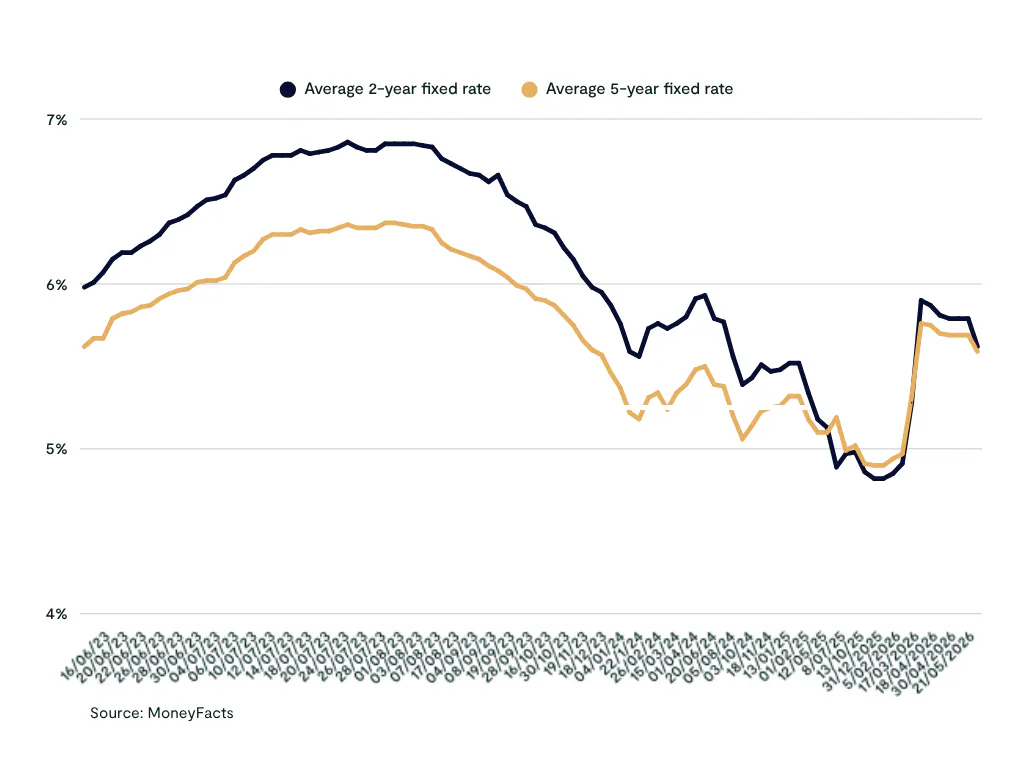
For buyers and remortgagers, the bigger influence on mortgage rates over the coming months is still likely to be the path of the base rate by the Bank of England, rather than the outcome of the leadership contest. Right now, the base rate is expected to increase at some point by the end of 2026, but there is no consensus on exactly when this could happen.
What Andy Burnham's housing policy could look like
Although he has not come out with any official policy (he hasn't been voted in after all!), based on Andy Burnham's previous comments, we can assume that housing policy would centre on a large-scale expansion of genuinely affordable social housing, tighter regulation of the private rented sector, and a fundamental reform of how property and land are taxed.
Replacing stamp duty with a land tax
At his campaign launch, Burnham described council tax as "highly regressive." One of his main criticisms is that bills are still based on 1991 property valuations, meaning lower-value homes often carry a disproportionately heavy burden relative to their actual worth.
Burnham has backed replacing council tax - and potentially stamp duty - with a land value tax (LVT). In an interview with LBC in 2022, he described land tax as a "very productive form of taxation because you make sure land is used for good, productive purposes, and if people are sitting on it and hoarding it, they get taxed, and that money can come back and be redistributed."
According to an IFS report, switching to a land value tax has a number of advantages, describing it as an "efficient way to tax a wealthy group". Supporters argue it would discourage land hoarding and encourage productive development. Critics, however, raise legitimate concerns about fairness - particularly for asset-rich, income-poor homeowners who might struggle to meet higher annual bills.
See what Stamp Duty you'll pay
Use our free Stamp Duty calculator to see what you could pay on your next home purchase, whether you're buying in England, Scotland or Wales.
Social housing could become a real focus area
The centrepiece of Burnham's housing agenda could be a council housebuilding programme on a scale not seen since the post-war era.
Burnham's consistent argument has been that council housing is not a niche solution and is central to resolving the housing crisis at scale, and has already shown how it could become central to his housing policy.
While he was Mayor of Manchester, the Greater Manchester Combined Authority set a long-term ambition to deliver 30,000 net-zero social rented homes by 2038. This weaved together the goals of improving existing housing stock, raising energy efficiency, and building genuinely future-proof homes.
On supply, Burnham has been equally concrete. Greater Manchester has pursued a target of 10,000 council homes by 2028, supported by efforts to identify brownfield sites and surplus public land that can be brought back into use.
In his Mayfield by-election campaign launch speech, Burnham also said he wanted "the biggest programme of council house building since the Second World War". He proposed redirecting the existing £39bn affordable housing programme entirely toward homes at genuine social rent.
For context, the UK has delivered roughly 50,000 affordable homes per year over the past decade, below an estimated need of around 145,000 annually. That gap, compounded over thirty years, is what Burnham's supply-first approach is designed to address - even if the delivery challenges would be formidable.
Burnham also previously advocated suspending the Right to Buy scheme on newly built council homes in high-demand areas, framing it as a way to protect scarce social housing stock from being lost almost as soon as it is built.
That will divide opinion, as for many home buyers, Right to Buy is a crucial route into homeownership. While housing advocates argue that selling off new social homes simply perpetuates the cycle of undersupply.
You might be able to borrow more than you think
Check your affordability in minutes without affecting your credit score.
Renting could get a shakeup
Burnham already has a history of transforming renting. His flagship initiative, the Greater Manchester Good Landlord Charter, sits at the heart of his "new deal for renters" - a framework designed to raise standards by combining tougher enforcement with genuine support for responsible landlords.
It is a carrot-and-stick model: landlords who sign up to the Charter gain access to grants of up to £30,000 for EPC improvements and retrofit works, while those who fall short face meaningful consequences. Financial penalties against landlords rose by 43% under the scheme, with total fines reaching £1.47 million - a signal that minimum standards are not optional.
In his byelection campaign, Burnham pushed for councils to have stronger compulsory purchase powers to acquire substandard rented homes. He has also advocated for:
- An independent inspection regime for rented properties
- A national landlord register
- Property improvement plans to give landlords a tailored blueprint for meeting standards
- A "three strikes and you're out" approach for landlords who repeatedly fail decent homes standards
Burnham has also previously sought powers to impose rent controls and argued that landlords exploited the cost-of-living crisis to push rents higher. In 2023, he wrote to then-Housing Secretary Michael Gove demanding those powers.
What might be implemented at the national level remains speculative. But the direction of travel under Burnham could be towards greater enforcement that is local, accountable, and properly resourced.
What does this mean for me?
It's important to keep in mind that none of this is fact. Burnham hasn’t yet been elected, and so we can’t know for sure what his policies will be. And even if he had been elected, potential changes to stamp duty, council tax, or wider property taxation could take years to materialise.
So, for first-time buyers or home movers hoping to move in the next 6 to 18 months, the biggest impact will be how the market responds to a leadership race.
With a stagnating economy just about absorbing the shocks from the conflict in the Middle East, any incoming leader will likely want to avoid unsettling the market with bold, uncosted announcements.
What should I do? Our top tips
Political uncertainty rarely helps people make major financial decisions, but waiting for the dust to fully settle before acting is rarely realistic either. Confidence matters when you're committing to a mortgage - and the UK's housing challenges are bigger than any one political leader.
- If you're a first-time buyer: Keep your focus on what you can actually control - how much you have saved as a deposit, understanding what mortgage rates you could get, and exploring affordability-boosting routes such as guarantor mortgages, shared ownership or higher lending schemes. Don't assume a new government will suddenly make the market dramatically more accessible overnight. The fundamentals matter far more right now than waiting for a policy announcement.
- For home movers: Any changes to stamp duty, or impact on house prices, are likely to be in the long-term, not the next 6-18 months. However, the uncertainty created by the Labour leadership race could influence the market. Ensure you are checking what mortgage rates you could be offered, and pricing competitively is crucial.
- For remortgagers: Burnham's housing agenda is most likely to show up through property tax reform, energy and building standards, and broader supply changes in the long-term. Not through any immediate impact on your existing mortgage deal. Your most pressing task remains reviewing your current rate, understanding when your fix ends, and sense-checking whether a remortgage could reduce your monthly costs.
- For landlords: The direction of travel points towards tighter standards and a more regulated environment, even if national policy ends up differing from Greater Manchester's model. Factor that into your planning now rather than later.
Conclusion
Andy Burnham’s housing agenda looks like it could be more focused on social rent and property taxation. But plenty remains uncertain, including the obvious - finding out who the next Prime Minister will be. In uncertain times, the best next step is to understand your own affordability, mortgage options and timeline - and get expert help.
Ready to take the next step?
Whether you're buying your first home, moving house or remortgaging, understanding your options is the best place to start. Our award-winning mortgage team can help you discover your best options from across the market.