





Bank of England holds Base Rate at 3.75%: What it means for your mortgage and savings
 Cesca Newton
 Today, the Bank of England’s Monetary Policy Committee (MPC) announced its decision to keep the UK base rate on hold at 3.75%.
While a rate hold might sound like a "no news is good news" story on the surface, what’s happening behind the headline rate matters directly for your wallet. Mortgage rates have been climbing, inflation remains above the Bank of England’s 2% target, and financial markets have become increasingly concerned that interest rates could rise again.
For savers, the picture looks rather different. With oil prices surging above $100 a barrel following escalated conflict in the Middle East, financial markets are increasingly pricing in the possibility of interest rate rises before the end of the year, with market swaps pricing in rate hikes as soon as November.
For savers, this shifting landscape creates a double-edged sword: higher rate expectations are keeping savings rates attractive, but persistent inflation threatens to erode cash that isn't working hard enough.
Whether you’re buying your first home, moving, remortgaging or building your savings, here’s what’s happening in the market, and what it could mean for you.

Key takeaways
- Base Rate is on pause, but mortgage rates aren't: The Bank of England kept the Base Rate at 3.75%, but fixed mortgage rates have actually been creeping up. Don't fall into the trap of assuming a hold means borrowing costs are standing still.
- Inflation and energy shocks are keeping markets on edge: With inflation rising to 3.1% in August and global oil prices spiking, markets are increasingly betting on rate rises before the end of the year rather than cuts.
- Playing the waiting game is risky: Trying to time the market is tough. If your deal is ending soon or you’re buying a home, securing a rate early protects you if market rates rise, and with tools like RateCheck, you can still switch if a cheaper deal comes along before completion.
- Low-deposit options are expanding: While house prices are splitting by region, over 8% of new mortgages are now for buyers with less than a 10% deposit, the highest share since 2008. Buying might be closer than you think.
- Savers need to make their money work harder: Higher rate expectations mean great returns are available (like Cash ISAs with 5.5% AER variable rates), but leaving money in low-yielding accounts means inflation will quietly erode its buying power.
The Bank of England has held the Base Rate at 3.75%
On Thursday 17 September, the Bank of England’s Monetary Policy Committee (MPC) voted 6 votes to 3 to keep Base Rate at 3.75%.
The Base Rate has been at 3.75% since December 2025, after the Bank gradually reduced it from a peak of 5.25% during the COVID-19 pandemic. According to the Bank of England, those reductions became possible as inflation fell and some of the pressures pushing prices higher eased. But the picture has changed considerably in 2026.
What's driving the Bank of England's decision?
The big issue is inflation, how quickly the prices of everyday goods and services are rising.
As of 16th September, inflation increased to 3.1% in August, up from 2.9% for July, and still well above the Bank of England's 2% inflation target.
The Bank is particularly concerned about what could push inflation higher from here. Conflict in the Middle East has disrupted global energy supplies and pushed up energy prices. Bank of England Governor Andrew Bailey has also warned that disruption to oil supplies and extreme weather could create further inflationary pressure through energy and food prices.
That's important because the Bank uses interest rates to try to keep inflation under control.
So far, Andrew Bailey has suggested these effects remain relatively subdued. That gives the Bank more room to wait and see what happens rather than immediately responding with another rate rise.
So, what’s going to happen next?
This is where things become less certain.
Ahead of September's decision, the majority of experts expected the Bank to hold rates at 3.75% on 17 September. Nearly 90% also expected Bank Rate to remain unchanged for the rest of 2026.
However, financial markets are now pricing in up to four quarter-point rate increases over the next 12 months, driven by escalating energy shocks and strong GDP data. Major global central banks have already raised rates, leading some analysts to argue that the Bank of England may have to follow suit before the end of 2026 to protect the pound and maintain its inflation-fighting credibility.
That doesn't mean a rate rise is 100% guaranteed. Economists and financial markets currently hold contrasting views on where Bank Rate will head next. But what is clear is that uncertainty has increased, and if you have a mortgage, or you're hoping to get one soon, this is particularly important.
What does this mean for mortgages?
Mortgage rates are rising, even though Base Rate hasn't
One of the biggest misconceptions about mortgages is that fixed mortgage rates simply move up and down with the Bank of England's Base Rate. They don't.
Bank Rate influences borrowing costs, but lenders also look at what financial markets think will happen to interest rates in the future. Fixed mortgages are particularly influenced by swap rates (essentially a measure of market expectations for future interest rates). When swap rates rise, fixed mortgage rates will often follow. When they fall, lenders may be able to offer cheaper deals.
That's why mortgage rates can rise before the Bank of England actually puts rates up or even while Base Rate is completely unchanged. The Bank itself explains that Base Rate influences borrowing and savings rates, but isn't the only factor determining them.
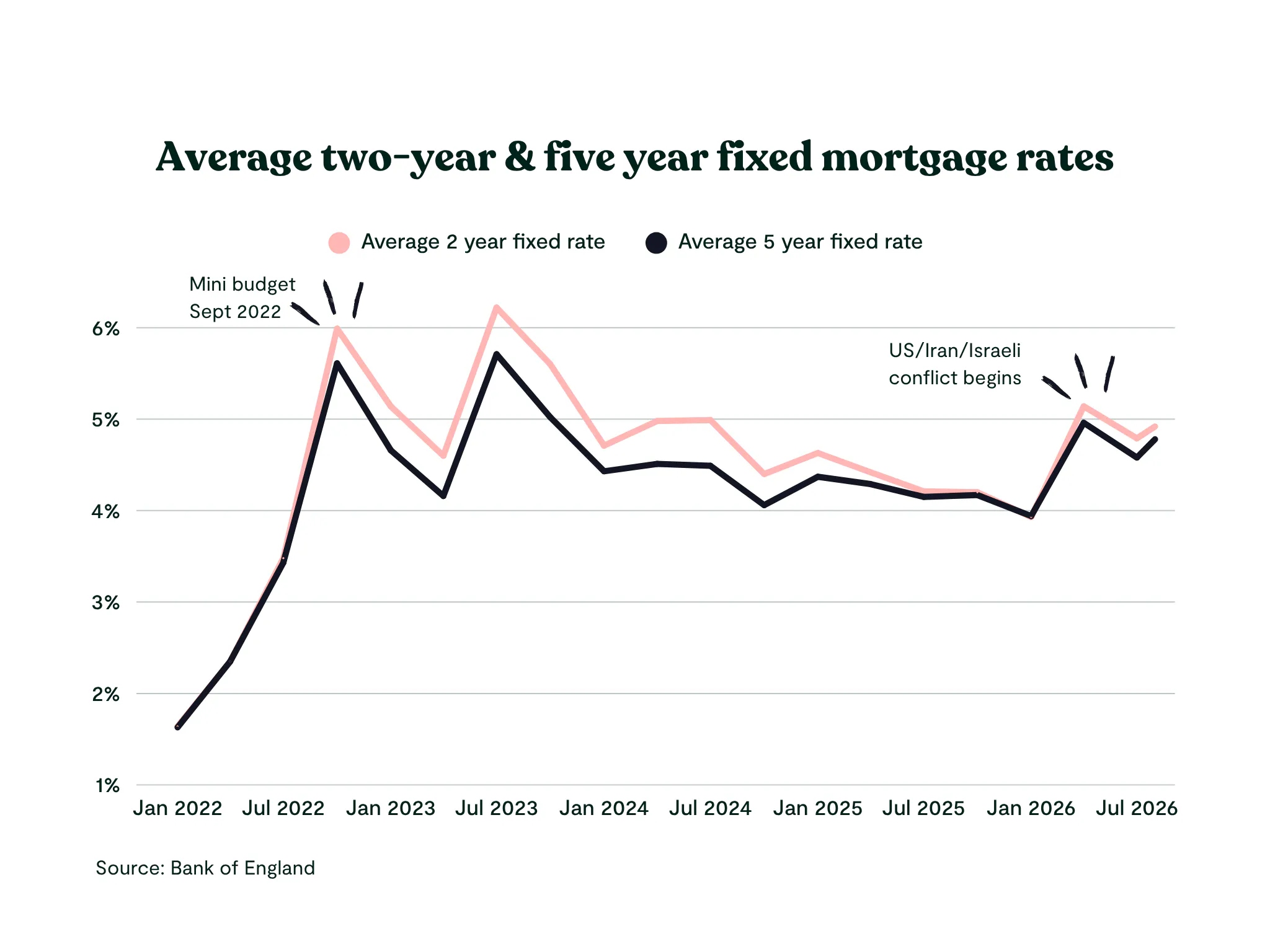
And we've seen exactly that happen recently. Nearly all of the UK's major mortgage lenders announced increases to the cost of home loans in early September. As of 16 September, the average rate on a new two-year fixed mortgage at 5.73%, while the average five-year fix stood at 5.78%.
Bank of England Governor Andrew Bailey has said UK mortgage rates were around 0.75 percentage points higher than they were when the conflict involving Iran began. And seemingly small movements in rates can make a significant difference to monthly repayments.
In fact, someone borrowing £250,000 on a typical two-year mortgage could now pay around £120 more a month than if they had secured their deal at the beginning of March.
Should you wait for mortgage rates to fall?
Trying to perfectly time the mortgage market is difficult, particularly in a market as volatile as this one.
And a Bank Rate hold doesn't necessarily mean cheaper mortgage rates are around the corner.
Several major lenders, including Natwest, Santander and Lloyds Bank, have increased mortgage rates as UK government borrowing costs rose. Other lenders also announced increases, reversing some of the gradual falls we'd seen in fixed mortgage rates previously.
That doesn't mean rates will definitely continue rising. They could fall again if the outlook changes. But if you're buying a home or your existing mortgage deal is coming to an end, waiting to see what happens could mean the deals available to you change in the meantime.
One option is to start exploring your mortgage options early. If you're remortgaging, many lenders allow you to secure a new mortgage several months before your existing deal ends.
Lock in now, check again later
With Tembo's RateCheck Service, if you've secured a mortgage through us and rates fall before completion, you can ask your Tembo adviser to check whether a better deal is available. If we find an eligible cheaper deal, we can explore switching you to it. If rates have gone up instead, you can keep the deal you've already secured.
What's happening to house prices?
Mortgage rates are only one part of the picture for buyers. There's also been a shift in house prices.
Average UK house prices fell 0.4% year-on-year in August, the first annual fall in almost three years. Prices also fell 0.2% between July and August, putting the average UK property price at £298,468. But that doesn't mean house prices are falling everywhere.
Prices in Northern Ireland were up 6.9% year-on-year, while Scotland recorded growth of 3.5%, the North East of England 2.7% and the North West 2.0%. At the other end of the scale, prices fell 1.6% in the South East and 1.5% in London.
So rather than a dramatic nationwide fall in house prices, we're seeing a market that's becoming slower and more price-sensitive. Some buyers are hesitating because of higher mortgage costs and wider economic uncertainty. At the same time, some sellers are reluctant to accept lower offers, meaning homes can take longer to sell.
For buyers who are in a position to move, that could create an interesting opportunity. Less competition and more price-conscious buyers can potentially create greater room for negotiation, although that will vary hugely by area and individual property.
Smaller deposits are becoming more common
There's another interesting shift happening in the mortgage market. The proportion of mortgage advances where buyers borrow more than 90% of their property's value reached 8.4% in the second quarter of 2026. That's the highest proportion since 2008.
In other words, more mortgages are being taken with deposits of less than 10%. That's particularly relevant for first-time buyers, because saving a large deposit can often be one of the biggest barriers to getting on the property ladder.
A smaller deposit won't be right or available for everyone, and borrowing more relative to your property's value can affect the mortgage rates available to you. But if you're assuming you need to save a huge deposit before you can even think about buying, it could be worth finding out what options are actually available to you.
Need to boost your buying budget?
Tembo searches mortgages from over 100 lenders, including specialist lenders and schemes designed to help eligible buyers overcome common affordability challenges.
What does the interest-rate picture mean for savers?
If you're a saver, there's another side to the uncertainty around interest rates. While higher interest rates can make borrowing more expensive, they can also mean better returns are available on savings.
Savings rates have risen alongside expectations for higher interest rates, although providers ultimately set their own rates based on a range of factors, including competition in the savings market. And when inflation is elevated, the rate your savings are earning becomes particularly important.
Why does inflation matter for your savings?
Inflation measures how quickly prices are rising. If prices rise faster than the interest you're earning on your savings, your money can gradually lose purchasing power.
Your actual balance isn't shrinking. But, over time, the same amount of money could buy you less.
If inflation climbs toward 4%, cash held in standard or low-yielding accounts will actively shrink in real terms. With central banks under pressure to respond, now is a crucial moment to check whether your money is earning enough to stay ahead.
We're saving differently, too
It's not just savings rates that are changing. What people are saving for appears to be shifting as well.
Recent research found that 17% of Gen Z savers were prioritising shorter-term goals such as buying a home, paying for a wedding or buying a car rather than contributing towards a pension, almost twice the national average of 10%.
That comes against a difficult backdrop for younger savers, who are balancing higher living costs with wanting to enjoy their money now and prepare for bigger goals later.
Saving doesn't necessarily have to mean putting every spare penny away for decades. Your savings can have different jobs: an emergency fund you need to access quickly, a house deposit you're building over several years, or money you know you won't need for a set period.
The important thing is choosing an account that works for what you're saving for and when you'll need the money. If you're worried that savings rates could fall in future and you have money you know you won't need for a while, a fixed-rate savings account can give you more certainty.
Earn up to 5.55% AER (variable) with Tembo Savings
From easy-access Cash ISAs and fixed-rate savings to accounts designed to help you get closer to your next mortgage, there’s a Tembo savings option to suit your goals.
So, what's the big takeaway this month?
A Base Rate hold might sound like nothing has changed. But that's far from the full story. For buyers and homeowners, the key takeaway is that you don't necessarily need to wait for the next Bank of England announcement to start exploring your options.
If you're buying soon or approaching the end of your current mortgage deal, finding out what's available now could give you more certainty, and services such as Tembo's RateCheck mean you can keep an eye on the market afterwards too.
For savers, it's a good time to check what your money is earning and whether your account still suits what you're saving for. If certainty matters to you, a fixed rate could be worth exploring. If access matters more, particularly if you're saving towards a home, an easy-access account may be more appropriate.
But you can make sure you understand what's happening, know your options and are ready to make a move when the time is right for you.
Learn more



YOUR HOME MAY BE REPOSSESSED IF YOU DO NOT KEEP UP REPAYMENTS ON YOUR MORTGAGE.
Full terms and conditions of our rate checking service can be found here.
Mortgage and savings products are subject to eligibility and terms and conditions. The value and availability of mortgage deals and savings rates can change.