





Tembo Market Watch: March 2026
 Anya Gair
Just when mortgage rates finally start easing, global events have thrown a curveball. Over the past few weeks, escalating tensions in the Middle East have sent oil prices climbing, rattled financial markets, and pushed mortgage rates back above 5%. Lenders have rapidly repriced deals, and hundreds of mortgage products have disappeared from the market almost overnight.
Whether you're a first-time buyer, a homeowner, saver, or just keeping an eye on the market, here’s what you need to know - from the UK's Best Mortgage Broker.
TLDR:
- The conflict in the Middle East is pushing up oil prices, which could drive UK inflation higher again.
- Average mortgage rates have jumped back above 5% as lenders rapidly reprice fixed-rate deals off the back of rising inflation fears. Don’t bury your head in the sand; see what rate you could get today from +100 lenders
- Bank of England holds base rate at 3.75% off the back of inflation fears. Future rate cuts aren’t out of the question, but depend on how the global economic situation develops.
- Cost of living could rise again as rising oil and energy costs could result in higher costs for businesses and rising inflation. Average petrol prices have already increased by 6.81p to 139.64p a litre since the conflict started.
- Savings rates remain relatively strong, with some Cash ISAs paying 4.62% AER (variable).
Let’s break down exactly what’s happening and what this means for you.
Should you lock in a rate now or wait?
Navigating mortgage deals can be tricky, especially with rates changing and new products popping up all the time. Our team of award-winning mortgage experts can help you find your best mortgage deal, and with our free rate checking service, your dedicated advisor can reapply for you down the line if rates drop*
Mortgage rates jump back above 5%
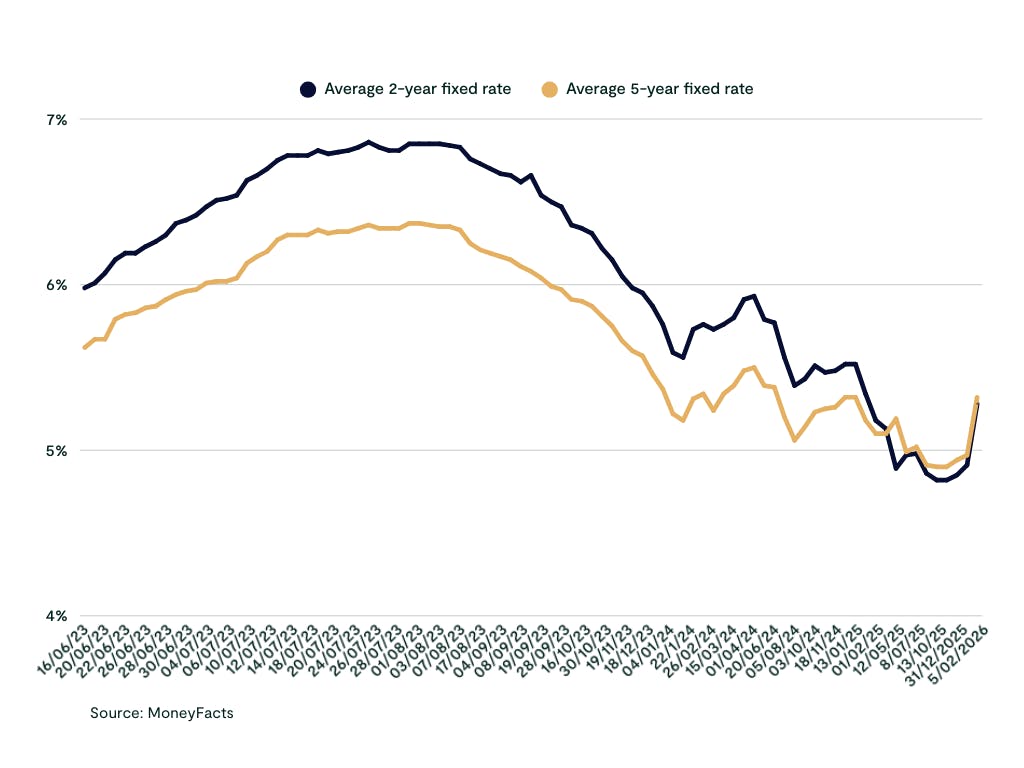
After months of cautious optimism as mortgage rates started to gradually fall, the outlook has suddenly changed. In the past week alone, nearly 500 mortgage deals were withdrawn from the market, including from several major lenders. The average fixed rate deal has now risen to 5.28% for two-year fixes and 5.32% for five-year fixes - the fastest mortgage market shake-up since the mini-budget turmoil in 2022 - impacting the affordability of mortgages.
Now, a typical new mortgage taken out is £788 a year more expensive than before the Iran war began. Although it’s important to remember that not everyone will see such a big increase in mortgage costs, as it all depends on your own individual affordability, as well as what lenders and deals you could be eligible for.
This sudden shift all comes down to rising inflation fears triggered by the conflict in the Middle East, which have pushed up the wholesale borrowing costs and swap rates - the market's forecast of future interest rates - which lenders rely on to price mortgages. As those costs increase, lenders typically respond by raising their own mortgage rates or pulling deals to reprice them.
This is why the base rate can stay the same, but fixed rate mortgage deals can change - mortgage rates are influenced by the base rate, they aren't led by it (unless it's a tracker rate).
Why does the conflict in the Middle East impact UK mortgage rates?
It might seem surprising that events thousands of miles away could impact your mortgage rate. But in global financial markets, everything is connected. The conflict in the Middle East has pushed up oil prices, which can increase the cost of energy, transport and food. This, in turn, risks pushing inflation higher again in the UK.
Higher inflation means the Bank of England may delay or even reverse cuts to its base rate of interest. Financial markets react to this risk immediately, pushing up swap rates, which mortgage lenders use to price fixed deals. So when swap rates go up, we typically see mortgage rates do the same. We’re already seen swap rates rise off the back of the conflict, causing many high street lenders to adjust mortgage pricing.
We’ve seen a noticeable surge in borrowers wanting to lock in rates while they still can, particularly those who planned to buy in the coming months. The good news is that buyer confidence appears to be holding up. Customer enquiries remain strong, and the positive momentum we’ve seen in the housing market so far in 2026 is continuing.

Richard Dana
CEO at Tembo
Base rate on hold for now, as Bank stays cautious
At midday on 19th March 2026, the Bank of England’s Monetary Policy Committee (MPC) voted to hold the base rate at 3.75%. The decision was widely expected in financial markets and reflects how the outlook for interest rates has shifted quickly in recent weeks.
Earlier this year, many economists had predicted the Bank could begin cutting rates in spring 2026 as inflation continued to fall. However, the recent surge in energy prices on the back of the conflict in the Middle East has made policymakers more cautious.
The main goal of the Bank’s MPC is to keep inflation close to the government’s 2% target. While inflation has fallen significantly from the double-digit highs seen in 2022–23, it still remains above target at 3%. Policymakers want to be confident that price pressures are continuing to ease before cutting rates further, which is why the recent conflict has caused the Bank to vote to hold.
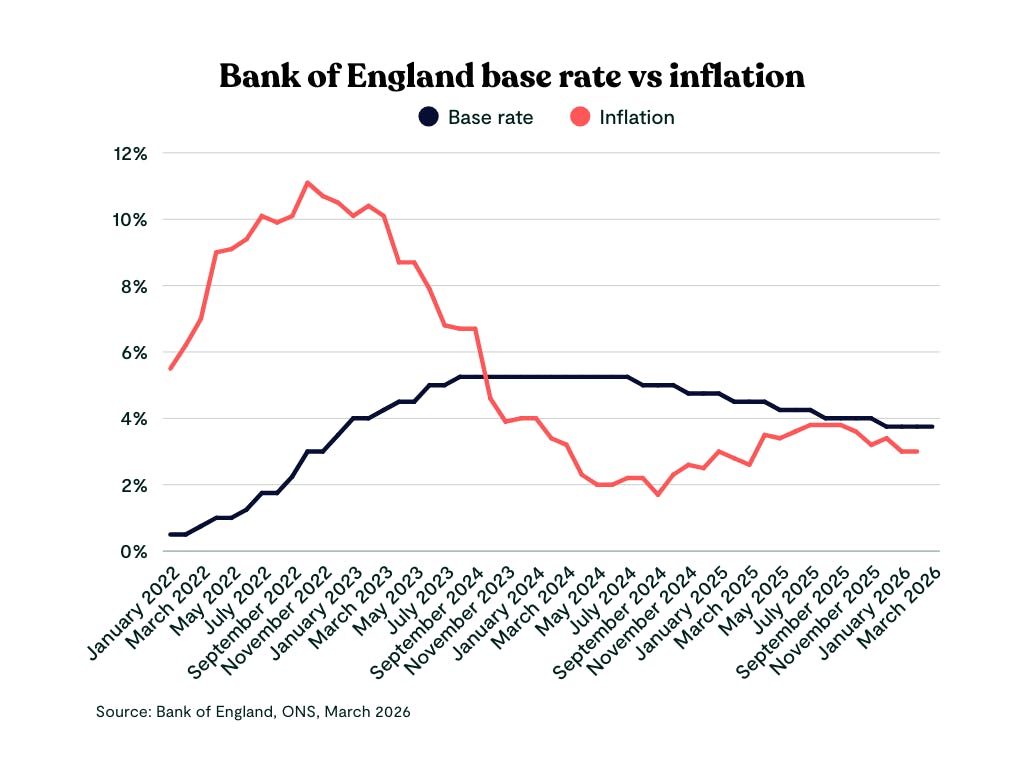
Despite holding rates this month, the Bank has indicated there could still be scope for rate cuts later in 2026 if inflation continues to fall as expected, but the chance of this happening seems to be becoming narrower by the day.
However, much will depend on how the global economic situation develops. If energy prices remain elevated and inflation rises again, policymakers may keep interest rates higher for longer.
It’s likely the MPC will continue to hold the base rate and monitor inflation until the situation in the Middle East is more stable. Although holding the base rate doesn't bring an immediate saving for many borrowers, it does allow the lenders to be much more aligned with swap rate movements and pass those savings on sooner without having to factor in base rate impacts too.

Andy Shead
Senior Mortgage Advisor at Tembo
What does this mean for you?
- First-time buyers: You might find you are now offered higher mortgage rates than you were a few weeks ago. Higher rates can mean higher monthly payments, and may also reduce the amount you’re able to borrow, which may impact the house price you can afford. However, rates could settle again, and there are still ways to boost borrowing through schemes like Income Boost, 5.5x Mortgages. Find out more here.
- Home sellers: Higher mortgage rates may impact what you could afford for your onward purchase, and what other prospective buyers can afford. Many lenders pulled deals temporarily to reprice them, meaning some new offers could reappear once markets stabilise. And keep in mind that, even though buyer confidence has dipped, people are still buying homes, and lenders are still competing for customers.
- Remortgagers: Around 1.8 million fixed-rate mortgages are due to expire this year, meaning many homeowners will soon need to find a new deal. If your deal ends soon, don’t wait until the last minute. Most lenders allow you to secure a new mortgage up to 6 months in advance, and with Tembo's rate checking service, you can reapply at no extra costs if rates drop down the line*. Get started here
With the market moving quickly, speaking to an expert broker early can give you far more options and help you make an informed decision. Discover your best mortgage options from +20,000 with Tembo today, the UK’s Best Mortgage Broker for four years running.
Understand how economic changes impact your mortgage options - in seconds
Get certainty on your best mortgage options from +100 lenders by completing your details online today with Tembo - it's free!
The cost of living could rise again
Mortgage rates aren’t the only concern right now. If oil prices remain high because of the conflict in the Middle East, your wallet could also face rising costs for expenses like petrol, diesel, and energy costs. We’ve already seen the average petrol prices increase by 6.81p from 132.83p to 139.64p a litre since the conflict started.
Although there is some protection in place for your gas and electric bills, thanks to the price cap set by energy regulator Ofgem, this is only in place until July, and doesn’t cover everyone. If the conflict continues into May, you could feel the impact of higher wholesale energy costs in your household bills from the summer.
When energy costs rise, those additional costs can be passed on to consumers through higher prices. Shipping disruptions can also play a role; if the conflict affects key trade routes, it can slow supply chains and increase transport costs for goods coming into the UK.
As energy, transport and raw material costs increase, many businesses face higher operating expenses. To protect their margins, companies often respond by raising prices for goods and services, which contributes to inflation across the wider economy.
Right now, the conflict is expected to add around 1% to UK inflation if energy prices stay elevated. That might keep inflation hovering around the 3% mark, reversing some of the progress made over the past year. Office for Budget Responsibility estimates that a sustained surge in oil prices could have a noticeable knock-on effect across the UK economy. But analysts are not expecting inflation to return to the 11.1% peak we saw in October 2022.
Some good news for savers
Higher inflation doesn’t just impact everyday spending; it also influences interest rates. While higher interest rates are difficult for borrowers, they can be good news for savers. Savings rates remain relatively strong compared to the ultra-low levels seen a few years ago, especially on tax-efficient accounts like easy access Cash ISAs, with some of the top rates as high as 4.62% AER (variable).
Cash ISAs allow savers to earn interest tax-free, with an annual allowance of £20,000 for the 2025/26 tax year. However, future changes are coming. The government has confirmed plans to reduce the cash ISA allowance to £12,000 from April 2027 for most savers. That means many people are being encouraged to maximise their allowance before the tax year ends.
Earn up to 3x more in interest than the Big 4 banks with Tembo's Easy Access Cash ISAs
Plus, unlimited withdrawals, fee-free mortgage advice, and monthly paid interest.
Tax treatment depends on individual circumstances and may be subject to change in the future. Capital at risk when investing; past performance is not a reliable indicator of future results.
What should you do? Our top tips
Whether you’re thinking about buying, remortgaging or just planning ahead, here’s a clear checklist to help you make confident decisions in the current market:
- If you’re a home buyer: Understand your true budget early, and get a Mortgage in Principle so you’re ready to move when the right property appears. Get one here.
- If you’re a remortgager: If your current fixed-rate mortgage is ending within the next 6–12 months, now is the time to start exploring your options. Don’t automatically accept your lender’s standard rate; instead, see your options from across the market with Tembo.
- If you’re a saver: Periods of economic uncertainty can make budgeting feel more difficult, so make sure your money is working as hard for you as possible. Explore our range of savings accounts here.
The key takeaway
Right now, the market is reacting to global uncertainty, and that means interest rates could move in either direction over the coming months. Shop around for the best savings rates, and work with a mortgage broker to help you move quickly when competitive deals appear.
Need support? We're here to help
We recognise that events in the Middle East may be affecting some of our customers, directly or indirectly. If you’ve been impacted and are concerned about your finances or mortgage, please get in touch with us - we’ll do our best to support you.
You may also find it helpful to speak to independent organisations such as Citizens Advice or the British Red Cross, who can offer free, confidential guidance.
Get a boosted savings rate when you buy or remortgage
With the HomeSaver savings account, earn a market-leading savings rate on your cash when you use our award-winning mortgage service.
Learn more



*Full terms and conditions of our rate checking service can be found here.
***Based on saving £100 at the beginning of each month for 5-years. Calculations show at month 61 (after 5-years) Tembo customers saving at 4.55% would have £343.33 on average more than saving with Barclays, HSBC, NatWest or Lloyds. Accurate March 2026.