





Tembo Market Watch: August 2026
 Anya Gair
The UK housing market is caught between two competing forces right now. Mortgage rates have been rising and falling depending on which lender you look at. Rewind a few weeks, and mortgage rates had started to fall as the potential ceasefire between the US and Iran initially appeared to hold. But the latest round of strikes and Houthi militia attacks on oil tankers in the Red Sea reignited fears over global energy supplies.
Some notable lenders are still reducing rates, but the picture is very much mixed. And with inflation expected to rise, any price reductions on fixed-rate mortgages could be short-lived. So if you’re on the fence, lock in your best deal while you can.
In Tembo's latest First-Time Buyer Index, we found that affordability for aspiring home buyers has reduced last quarter vs the quarter before. If you’re hoping to buy soon, this may mean you have to compromise on location or budget to make homeownership happen. But there is a lot of choice available at the moment - with many buyers holding off, there’s less competition, and 55% of properties for sale have had their asking prices reduced.
For savers, the current economic uncertainty makes it more important than ever to make sure your money is working as hard as possible, especially with the risk of rising inflation.
If you're trying to work out whether to save, buy, move, or remortgage, here's a clear-eyed look at what's actually happening, and what it means for you - from the UK's Best Mortgage Broker (five years running!) and award-winning savings platform.
Key takeaways
- Mortgage rates remain volatile, with average two- and five-year fixed rates rising to 5.63% and 5.67% respectively, although some lenders have started cutting rates.
- First-time buyer affordability has worsened, with the First-Time Buyer Attractiveness Score falling from 637 to 589 as house prices and mortgage rates increased.
- Buyers have more choice, with 9% more homes available than in Q1 2026 and 55% of properties on the market having had their asking prices reduced.
- Regional affordability varies significantly, with northern cities generally offering lower entry costs and stronger opportunities to build equity than southern England.
- Inflation remains a key risk, as disruption to oil and gas supplies could push inflation higher, limiting the Bank of England’s ability to cut interest rates.
- For savers and homebuyers, reviewing your savings and mortgage options is more important than ever while rates and the wider economic outlook remain uncertain.
Compare live mortgage rates across the market
See the best deals from our panel of over 100 lenders instantly with our free comparison tool.
Mortgage rates remain volatile as some lenders cut while others raise rates
Mortgage rates over the last few weeks have continued to be a bit of a rollercoaster. The average two-year fixed rate has risen to 5.63%. Although this is way below the peak of 5.9% back in April from the Iran war, it has more recently been rising, while the average five-year fixed rate is now 5.67%.
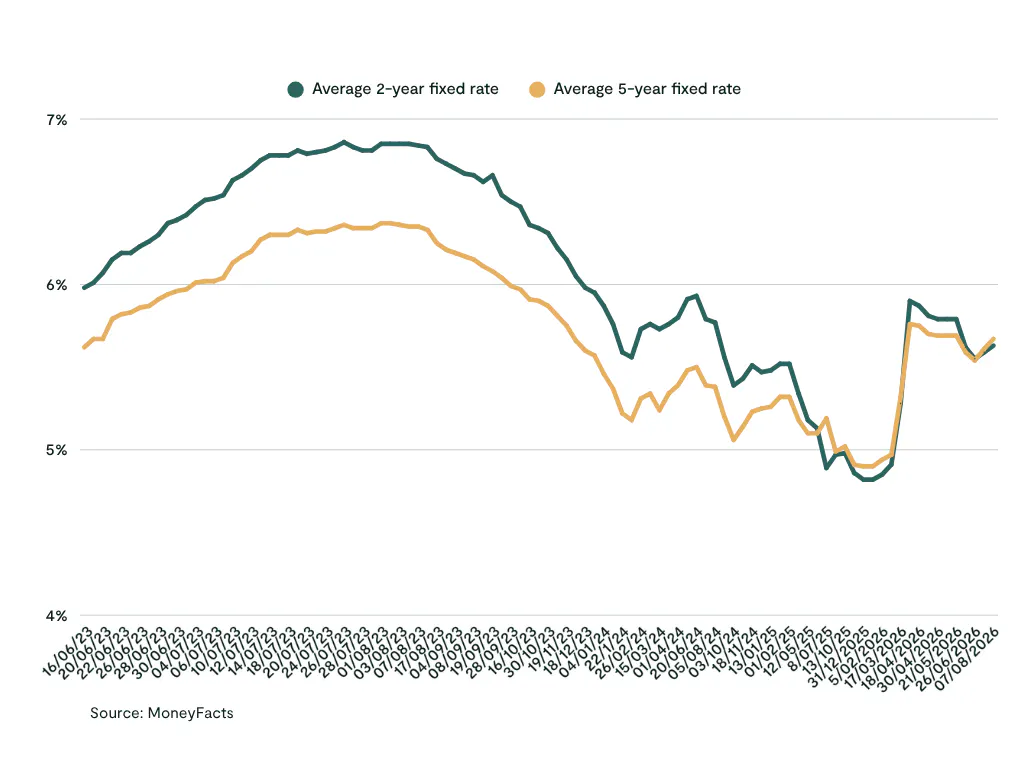
This has been driven by rising oil prices and uncertainty over the US-led conflict with Iran. Recent strikes and Houthi militia attacks on oil tankers in the Red Sea have reignited concerns over energy supplies.
It may seem that all the positive movements over the past few weeks have been lost. But there are signs of movement.
Nationwide became the first major lender to cut rates in early August 2026, reducing selected deals by up to 0.19%, with its lowest fixed rate falling to 4.52%, in response to falling swap rates.
Swap rates are used to price fixed mortgage rates as they indicate which way the market thinks interest rates will go. They have fallen recently on the back of Donald Trump promising new talks on ending the conflict in the Middle East.
Gen H - a specialist lender on our panel of 100+ lenders - was also quick to respond by cutting rates by up to 0.40%. But so far none of the biggest high street names has followed; in fact, some lenders are increasing rates, such as Halifax, which has increased rates for home buyers by up to 0.12%.
| Mortgage type | Average rate available |
|---|---|
2 year fixed rate | 5.61% |
5 year fixed rate | 5.64% |
*Sourced from Moneyfacts. Rates accurate as of the 14th August 2026.
Protect yourself with Tembo's RateCheck service
We search over 100 lenders and 20,000+ products to lock in the lowest mortgage deal available for you right now. If rates happen to fall before you complete, you can ask your dedicated Tembo advisor to reapply for the cheaper deal at no extra cost. If rates rise, your lower rate is already safe.
Affordability has worsened for the first time in nearly two years
In Tembo's latest First-Time Buyer Index, we found that rising house prices and higher mortgage rates during April and May pushed the market’s First-Time Buyer Attractiveness Score down from 637 in January-March to 589 in April-June, moving the market from "High" to "Moderate" attractiveness for first-time buyers. For aspiring home buyers, this may mean having to compromise on location or budget to make homeownership possible.
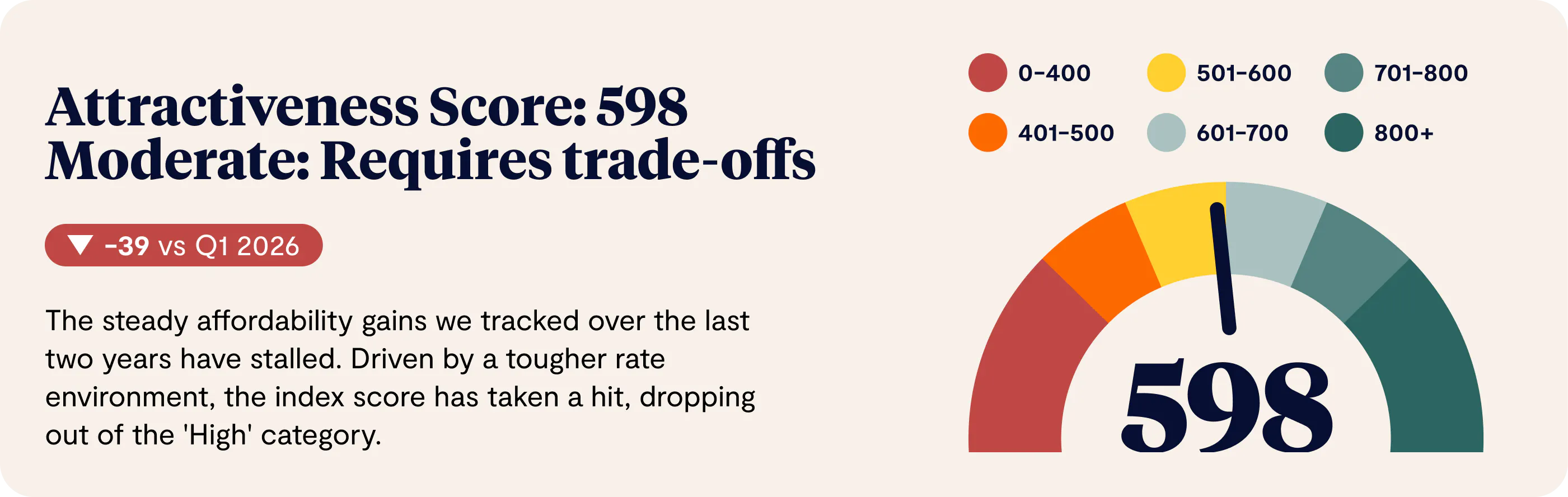
But for those who are able to buy right now, there is much more choice, with 9% more homes available nationwide compared to the first quarter of 2026. Although more homes won’t fix high interest rates, it does mean an advantage for buyers. You may have the best pick of the crop, and with less competition from other buyers, you may be able to negotiate a lower price.
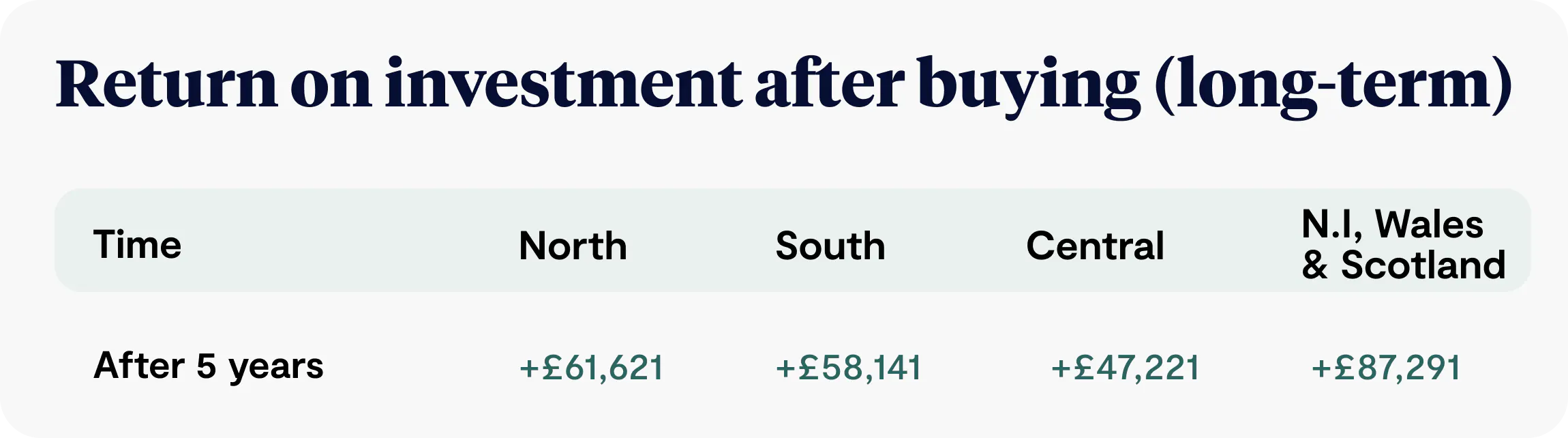
And if you’re on the fence about whether to take the leap, remember that homeownership remains one of the strongest ways to build wealth over a five-year period, with a return on investment between £47-87K depending on where you buy.
You might like: How to negotiate on house price
House price growth continues to slow, but the postcode penalty is widening
Where you buy now has a greater impact on affordability and long-term wealth than national housing trends. Overall, annual house price growth has slowed significantly to 1.3%, down from 1.7% a year ago. The average UK home now costs £271,900, having gained around £3,400 in value so far this year, with 55% of properties on the market having had their asking prices reduced, indicating that sellers are having to adjust their expectations to attract buyers.
However, the picture varies widely by region.
Buyers in northern cities can typically build equity much faster, while those in southern England face significantly higher deposits and mortgage repayments. In Tembo's latest First-Time Buyer Index, we found that buying in the North continues to deliver massive, immediate value for buyers. Lower entry costs make homeownership more accessible, allowing you to build equity from the outset while benefiting from local property price growth.
While many southern buyers need to borrow well above traditional lending multiples, making homeownership increasingly difficult without larger deposits or specialist mortgage schemes. This may make you reconsider buying in the next year, but remember that homeownership still generates substantial, life-changing wealth when you look at a five-year horizon.
Andy Burnham aims to pair more affordable housing with radical planning reform
With Andy Burnham becoming Prime Minister on 20th July 2026, housing has moved to the heart of the government's agenda. His plans focus on accelerating housebuilding, devolving more powers to regional leaders and making homeownership more accessible.
While large-scale reforms won't transform the housing market overnight, the government's early priorities suggest several important changes are on the horizon. This includes the biggest council housebuilding programme in decades by unlocking unused public land for building social and council homes. There are also new house buying rules coming which promise to simplify the planning system.
More homes, faster planning decisions and greater support for buyers and renters could gradually improve affordability and make it easier for more people to get on - and move up - the property ladder.
Is a fresh inflation shock on the cards?
The UK economy could face a fresh inflation shock and potential recession if disruption to the Strait of Hormuz continues.
The biggest risk comes from disruption to oil and gas supplies passing through the Strait of Hormuz, a critical global energy route. Higher oil prices would increase costs across the economy, from petrol and heating bills to transport, manufacturing and food production.
Inflation could rise sharply if the conflict continues, potentially to around 6.4% by the end of the year, more than double previous expectations. This would reverse some of the progress made in bringing inflation down and put renewed pressure on household budgets.
If the Straits remain closed into 2027, higher energy costs and weaker consumer spending could push the UK economy into a recession. Rising fuel, energy and food costs would reduce disposable income, making it harder to save. This could particularly affect households already dealing with higher mortgage payments and rents.
A fresh inflation surge would also make it harder for the Bank of England to reduce its base rate of interest, as policymakers would need to balance supporting economic growth with preventing inflation from becoming entrenched.
Read more: What happens to mortgage rates in a recession?
What does August’s Market Watch mean for savers?
For people saving in the short term (0–2 years)
For those building an emergency fund or saving towards a near-term goal, the biggest challenge remains balancing earning a competitive interest rate with maintaining flexibility. Inflation has fallen significantly from its recent peaks, but the risk of another energy-driven inflation shock means the value of cash savings could still be eroded over time if returns don't keep pace. Make sure you keep short-term savings in accounts designed to maximise interest while protecting access to your money.
For long-term savers (2+ years)
For people saving over many years, such as for retirement, a house renovation or other future financial goals, inflation remains the key risk. Money sitting in accounts with low interest rates for too long, or simply not the most competitive rates on the market, can lose purchasing power if inflation rises faster than savings returns. Focus on consistently saving if you can, and review your interest rates to ensure your money is working as hard as it can be. You might find a more competitive rate from another provider.
For people saving for a milestone like a house deposit
Similar to those saving for the long-term, if you’re saving towards a big life goal like buying your first home, it’s crucial to ensure you’re earning a competitive interest rate on your savings. Look into different savings accounts which could help you reach your goal sooner, like a Lifetime ISA if you’re a first-time buyer, which gives you a free 25% boost to your deposit of up to £1,000 each tax year. Or our HomeSaver savings accounts, which offer up to 5.5% AER (variable), combining a 3.0% AER variable base rate and a conditional 1-year 2.5% AER fixed bonus when you complete your mortgage through Tembo.
HomeSaver account must remain open until the bonus is paid. One HomeSaver bonus payable per mortgage.
Save with the market-leading Cash Lifetime ISA
Earn 4.46% AER (variable) on your savings with the Tembo Cash Lifetime ISA. That's hundreds more in interest towards your house fund vs saving with the closest competitor!
Comprised of a 3.55% AER (Variable) underlying rate plus a 0.91% AER 12-month introductory rate applied for 380 days from submitting your application. Introductory rate for new customers only. Withdrawals from a Lifetime ISA for any purpose other than buying a first home (up to a value of £450,000) or for retirement (60+) incur a 25% government penalty, meaning you may get back less than you paid in.
What does August’s Market Watch mean for mortgages?
- First-time buyers: Don’t let changing mortgage rates put you off buying. If you can afford to get on the ladder now, it could be a good time to take the leap, as there is less competition from other buyers. Plus, with a slower market, you are more likely to be able to negotiate money off your house purchase. See what you could afford now for free, including indicative interest rates and monthly costs.
- Home sellers: While rates are chopping and changing, many buyers are holding off, and those in the market have choice on their side. Pricing realistically is crucial for a successful home sale - keep in mind that 55% of properties on the market have had their asking prices reduced, so pricing too high could make a sale unlikely. The mortgage rate on your next purchase may be higher than a few months ago too. Check what mortgage deals you could be eligible for today without applying.
- Remortgagers: For those leaving fixed rate deals locked in 2-5 years ago when rates were lower, the most important thing you can do now is act early. Rolling onto your lender's standard variable rate (SVR) - currently averaging around 7.13% - when your fixed rate deal ends could cost you significantly more than locking into a new deal. See your options today for free.
The bottom line
The UK housing market is navigating a genuinely uncertain period, with mortgage rates changing in response to global and national events that are difficult to predict. But this doesn’t mean it’s the wrong time to get on the ladder, or you need to start saving cash under your mattress. Whatever stage you're at - saving, buying, moving, or remortgaging - understanding your options now puts you in a stronger position than waiting for certainty.
Let's make home happen
Complete your options online with Tembo to see your best mortgage options from across the market in minutes, all without applying. So you can make an informed decision on your next move.
Learn more


Full terms and conditions of our rate checking service can be found here.