





The UK's Best Mortgage Broker
As voted by our customers, five years running
The home for first-time buyers
Buying your first home can feel overwhelming. That's where our award-winning savings and mortgage platform comes in. By your side from your first £1 saved until you get your keys, with expertise at every step from the UK's Best Mortgage Broker five years in a row.


As seen in











By your side from the first £1 saved to buying your dream home
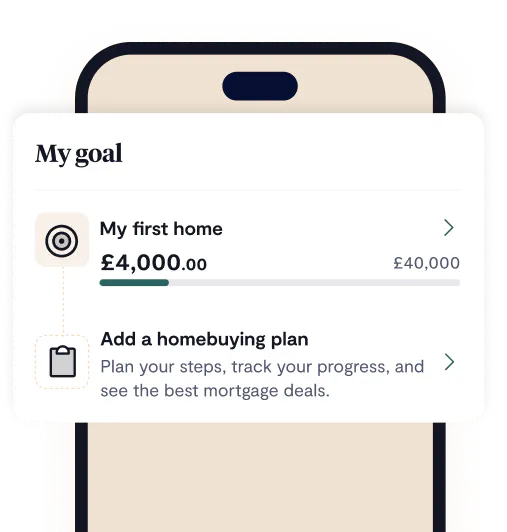

Get a tailored homebuying plan

Complete first-time buyer guide
Buying your first home involves a lot of moving parts, from working out what you can afford to picking the right mortgage. Here's everything you need to know, step by step.
Save for your deposit faster
A Lifetime ISA is one of the most effective tools available to first-time buyers in the UK because the government adds a 25% bonus on top of whatever you save, up to £1,000 extra per year. That bonus is paid monthly (or added to contributions), so your money starts growing with the government top-up well before you've finished saving. It can be opened by anyone aged 18-39, and used toward a first home worth up to £450,000.
There are a few rules worth knowing before you open one: your money needs to stay in the account for at least 12 months before it can be used toward a house purchase, and if you withdraw it for anything other than a first home (or retirement after age 60), you'll pay a withdrawal charge that effectively claws back the bonus and a little of your own money too. Because of this, it's worth being reasonably confident about your buying timeline before locking money away, though pairing it with a separate instant-access savings pot for shorter-term needs is a common approach.
How much can you afford?
Most lenders will offer 4 to 4.5 times your income, but that's rarely the full picture. Affordability isn't just a multiple of your salary, though that's where most lenders start.
Most will offer 4 to 4.5 times your annual income as a baseline, but they'll then stress-test that figure against your actual outgoings: existing loans, credit card balances, car finance, even subscription spending shows up on some assessments.
Two people on the same salary can be offered very different amounts depending on how much of their income is already committed elsewhere. This is why a "quick" online calculator often gives a different answer to what a lender will actually offer once they've looked at your full financial picture.
Some borrowers can unlock more than 4.5x
Specialist schemes could push your borrowing to 5x, 5.5x, or more, depending on your job, deposit, and whether a family member can help. Certain professions (like NHS staff, teachers, and other public sector roles) can access enhanced income multiples of 5.5x or even 6.5x through specific lenders. Using a family member's income or savings as security, or unlocking equity from the family home, could also increase what you're able to borrow through a guarantor or family-assisted mortgage.
Before you apply, it's worth gathering your last 3 months of payslips or accounts (if self-employed), bank statements, and a summary of any existing debts, as this is exactly what a lender or broker will ask for to give you an accurate number rather than an estimate.
Keep reading: Guide to how much first-time buyers can borrow
How much deposit do you need?
Your deposit is the percentage of the property price you pay upfront, with a mortgage covering the rest. Most first-time buyer mortgages ask for a minimum of 5%, though putting down more (10%, 15%, 20%) usually unlocks better interest rates meaningfully, since a bigger deposit means less risk for the lender. This relationship is called loan-to-value, or LTV. A 5% deposit means a 95% LTV mortgage, while a 20% deposit brings that down to 80% LTV, which typically sits in a much cheaper rate bracket.
Where the deposit money comes from matters too. Lenders will usually want to see at least 3 months of bank statements and evidence showing where your savings are built up. If any part of your deposit is a gift from family, most lenders require a signed "gifted deposit letter" confirming it's not a loan that needs repaying. If you're saving toward a deposit rather than already sitting on one, a Lifetime ISA can add a 25% government bonus on top of what you put in, which is often the fastest legal way to close a deposit gap.
Learn more: Our full guide to saving & boosting a deposit
Boost your budget with specialist schemes
If a standard calculator has told you that you can't afford much, that's often not the full story; it's just what one lender's default criteria produces. Specialist schemes exist precisely because most people's financial situations don't fit neatly into a generic formula. A guarantor mortgage lets a family member use their income, savings or property to help you afford more, without necessarily going on the property deeds.
These schemes aren't a last resort; they're commonly used by buyers with perfectly stable finances who simply want to buy sooner, or buy in a more expensive area, than a standard mortgage would allow. Eligibility varies by scheme: some require the helping family member to also go through a credit and affordability check of their own, and most require legal advice for everyone involved before completion. A specialist broker can help you work out if these schemes are a viable option for you.
Keep reading: Guarantor mortgages explained
Is now a good time to buy?
It's a question every first-time buyer asks, and the honest answer depends on your own situation more than the headlines. Mortgage rates and house price growth matter, but what matters more is what you can afford, how long you plan to stay in the property, and whether your monthly rent is already costing you more than a mortgage on a similar property would.
A useful way to think about it: buying makes sense when you can comfortably afford the monthly repayments with some room to spare, you're not planning to move again within the next 2-3 years, and you have a deposit plus a buffer for moving costs, legal costs and stamp duty.
Market timing is far less important than most people assume. Trying to wait for rates to drop or waiting for prices to fall can mean waiting years, with no guarantee this will happen. What matters is whether buying is right for your circumstances now, not whether this month happens to be the cheapest possible moment to do it.
Get a Mortgage in Principle
A Mortgage in Principle (MIP) is a document estimating how much you could be lent for a mortgage, based on a quick check of your income and outgoings. It's different from an Agreement in Principle, and is not a guaranteed mortgage offer; that only comes later, once you've found a property and gone through a full application. But it's a strong signal to estate agents that you're a serious, ready buyer, and many agents won't book viewings without seeing one.
Getting one is usually quick and free - you can get one through Tembo in under 10 minutes! You'll typically need to provide details like employment status, income, outgoings and dependants. But no payslips or bank statements are usually required at this stage; those come later at full application. It's worth getting a Mortgage in Principle before you start viewing properties seriously, both to know your realistic budget and to move faster once you find the right home.
Budget for stamp duty and other costs
Stamp Duty Land Tax (SDLT) is a one-off tax paid when you buy a property in England or Northern Ireland (Scotland and Wales have their own equivalent taxes with different thresholds). First-time buyers benefit from relief: currently, no stamp duty is due on the first £300,000 of a property's value, with a reduced rate applying on the portion between £300,000 and £500,000. Above £500,000, first-time buyer relief no longer applies, and standard rates kick in.
Stamp duty isn't the only extra cost to budget for
Expect to pay for a property survey, conveyancing or solicitor fees, a mortgage arrangement fee (some lenders charge this, others don't, and it can sometimes be added to your mortgage rather than paid upfront), and a broker fee if applicable. Budgeting for these on top of your deposit is a sensible move to avoid surprises close to completion!
With Tembo One, you can get everything covered - award-winning mortgage advice, legal work, property survey and fall-through protection - all for one fixed cost with no hidden surprises.

Apply for your mortgage
Once you've had an offer accepted on a property, you’ll need to go through a full mortgage application. This is where the paperwork gets more detailed: lenders will typically ask for 3 months of payslips (or 2-3 years of accounts/tax returns if you're self-employed), 3-6 months of bank statements, proof of ID and address, details of the property, and evidence of your deposit source. A full affordability assessment follows, along with a valuation of the property itself to make sure the lender is comfortable with what they're lending against.
Going through a whole-of-market broker (like us) at this stage means your application is matched against a wide range of lenders, rather than just whichever bank you happen to already use. This matters because lending criteria vary significantly between providers, especially for specialist situations like self-employment, new build properties, or boosted borrowing. A good broker will also flag likely issues before you apply (rather than after a lender declines you), which keeps the process quicker and protects your credit file from unnecessary hard searches.
Is buying right for you this year?
There's no universally "good" or "bad" year to buy; it depends more on you than the market. If your rent is close to what a mortgage would cost, your income's stable, and you're not planning to move again within 2-3 years, waiting rarely pays off.
However, it might be worth holding off on buying if you're not confident you'll stay put for a few years, if you'd be stretching to the very top of what a lender offers, or if you wouldn't have a buffer left for moving costs and the unexpected. A mortgage is a decades-long commitment, so "just about affordable" today leaves no room if things change.
The more useful question isn't "is this a good year?", it's "am I ready?" A broker can talk through your actual numbers and tell you honestly whether now makes sense, or whether it's worth another year.
How to get started:
Best fixed rate mortgages
Your interest rate stays the same for a set period, giving you certainty and stability.
Best variable rate mortgages
Your rate moves with the market, offering flexibility.
How do mortgage deals work?
Our essential guide walks you through how mortgage rates work, in everyday language.

Discover your true buying budget from +100 lenders
Discover your true buying budget from +100 lenders
Best fixed rate mortgages
Your interest rate stays the same for a set period, giving you certainty and stability.
Best variable rate mortgages
Your rate moves with the market, offering flexibility.
How do mortgage deals work?
Our essential guide walks you through how mortgage rates work, in everyday language.
Specialist mortgages
Why use Tembo?
Our service is designed to guide you through the whole process of buying your first home, with award-winning mortgage advice from start to finish.

Save your deposit
Save faster with our market-leading Lifetime ISA. Open or transfer today.

House hunt
Get a Mortgage in Principle online for free in minutes, ready to start house viewings

Put in an offer
Get free property reports to help you offer on your dream home with confidence

Find your best mortgage deal
Through our award-winning mortgage service, voted the UK's Best Mortgage Broker five years running.

Your own dedicated team
By your side from the first hello to getting your keys to your new home.

Access to our panel of conveyancers
Tried & tested paid legal guidance from our panel of experts

Trusted by thousands of first time buyers across the UK
Our mission is to make home happen for the next generation of first home buyers. We simplify the process, cut through the jargon, and use our expertise and award-winning smart tech to find all the ways you could buy sooner, including how you could boost your budget.
Single income first-time buyer
Buying with complex income
First-time buyer in London
Using income to boost affordability
Remortgaging to gift a deposit
Acting as a silent guarantor
Your first-time buyer toolkit




Common first-time buyer questions
See all FAQsFrequently asked questions
Related first-time buyer guides
Tools and calculators


Stamp duty calculator
Work out what you may have to pay in Stamp Duty on your first home.

*Fee-free mortgage advice is subject to eligibility, see terms & conditions here. Best Mortgage Deal Guarantee subject to eligibility, see terms & conditions here